How to Create a Test Automation Strategy

To deliver high-quality software faster and more efficiently, organizations have adopted Agile and DevOps. Test Automation is a key enabler of agility. However, Test Automation investments can be hampered by ineffective strategies.
This article will talk about how to create an intelligent Test Automation strategy that can prevent common Test Automation failures.
1. Find Your Test Automation Goals, Measure Success

Without a goal, Test Automation is useless. To develop a Test Automation strategy, the first step is to identify goals that will measure success.
These questions will help you to identify your automation goals.
- Which problems do you want to solve with Test Automation?
- How can you achieve maximum ROI with minimal effort?
- Which test cases should you automate
- What does automation mean for your current processes and workflows.
- Are your employees equipped with the right skills?
Your Automation goals should be quantifiable. Define the "success" criteria and establish the parameters that will measure your Test Automation's success. Learn more about how to measure success and performance using KPIs in Test Automation
2. How to use the Test Automation Pyramid to devise a Test Automation strategy
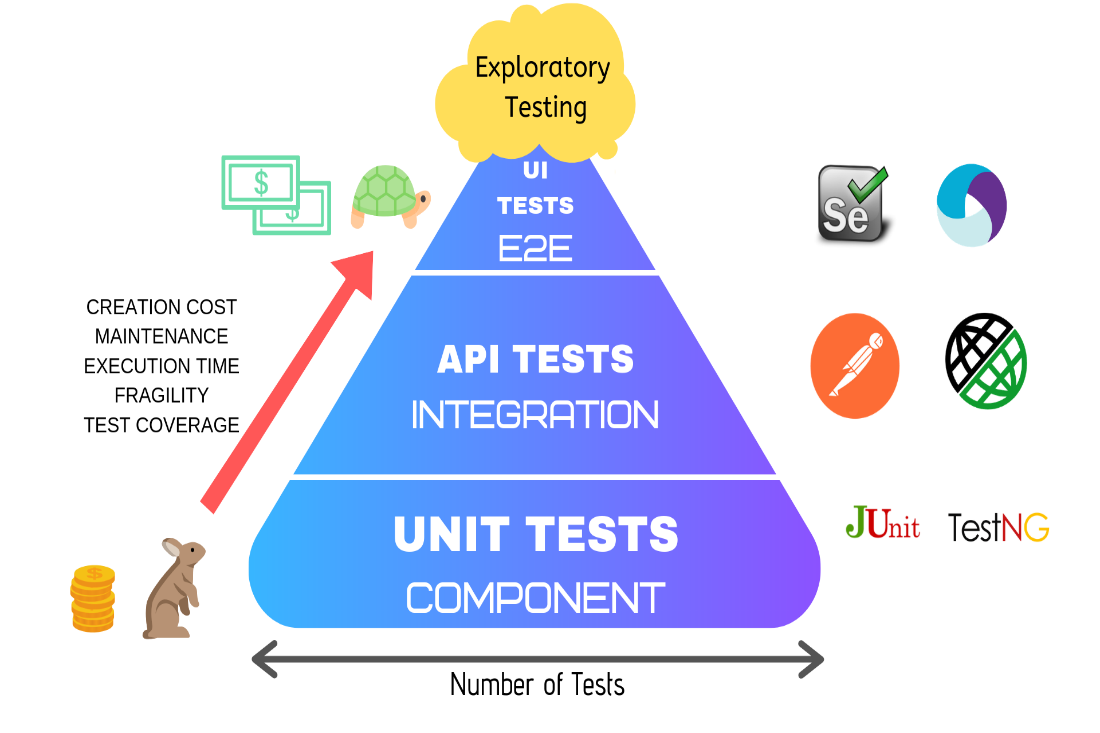
Mike Cohn's Test Automation Pyramid concept can be used to help you formulate a test automation strategy.
Figure 1. Illustration of Mike Cohn’s Test Automation Pyramid concept.
The Unit Tests are located at the base of the pyramid. They are the cheapest to create and are the easiest to execute. The number of tests that can be created at each level is determined by its width. Unit tests should be the bulk of our tests.
The API tests are performed against the service layer in the middle. The UI tests at the top of the pyramid validate the application's functionality at the presentation layer.
The cost of creating and maintaining tests, test execution time, test fragility and test coverage all increase as we climb the pyramid. For a better return on your investment, the Automation Pyramid recommends that tests should be pushed to the lowest possible level.
The little cloud at top of the pyramid indicates that your product needs to be tested in exploratory ways, even if it has solid automation at all levels.
3. Defining your Test Automation Strategy
Automate test cases. Prioritize cases that generate ROIfastly. Once you have identified the task you wish to automate, you can choose the best time to do it.
People and Tools
It is crucial for Test Automation's success that the right people are hired for its implementation. Automation is the foundation of all initiatives. Automation must be owned by someone who is available to work full-time. The Automation leader should either create a new team or train existing team members according to the context. The Automation lead should clearly identify which members of the team are responsible for what part of the Automation project. The team should meet regularly to assess the progress and goals against their KPIs.
It is essential to choose the right tool for Test Automation success.
Consider these factors when choosing a functional Test Automation Tool:
- Is the tool compatible with current SDLC processes
- Is the vendor able to provide training and reliable support?
- Are you able to compare the available tools on the market?
- What programming languages does it support Do you have the right skills for your team?
- Are you able to afford the tool?
- Use an open-source tool - Does it have good community support? Do they provide well-written documentation and documentation?
- Are you able to foresee the vendor running out of stock, or the acquisition or retirement of the tool?
Remember that tools must adapt to you, not vice versa. It is a smart decision to choose a tool set that works with your existing skills and has a minimal learning curve. TestArchitect is a code-free tool for automating. It offers freemium options to help teams get started.
4. Automated Test Lifecycle Methodology
Elfriede dustin "Automated Test Lifecycle Methodology, (ATLM), is a structured method that is designed to ensure the successful implementation and maintenance of Test Automation." ATLM will allow you to visualize the process for Test Automation.
Figure 2 -- ATLM, as described in Automated Software Testing, Introduction, Management and Performance by Elfriede dustin, Jeff Rashka, John Paul
Six components make up the Automated Test Lifecycle Methodology, (ATLM), (Elfriede dustin, Jeff Rashka, and John Paul, 1999).
- The Decision to Automate Test: Managing expectations and communicating the potential benefits of automated test to management
- This stage is for the acquisition of test tools. The evaluation and selection process are done here.
- Automated Testing Introduction: Test goals and strategies are established and documented.
- Testing, Design, and development: This stage outlines roles and responsibilities, schedules and test plans, design activities, test environments preparation, contingencies and risks, as well as the test environment.
- Execution of and Management of Testing: Perform the planned unit, integration and system testing and user acceptance testing.
- Evaluation and Review of Test Programs: This is an ongoing activity that collects lessons learned and takes corrective steps to improve the process.
Summary
You can see that Test Automation success is complex and multifaceted. The first step to success in Test Automation is to define your goals and follow a structured approach. After that, success in Test Automation is dependent on the selection of the right people and tools. It is OK to ask for help when it is not within your reach. Your Automation efforts will be more successful if you enlist the assistance of an expert firm. LogiGear, for example, is a company that has 25 years of Silicon Valley testing expertise. We can provide the tools and training you need to achieve Automation the right way the first time.
Go to https://testarchitect.com to get your free no-code automation tool
-- -- -- -- -- -- -- -- -- -- -- -- -- -- -- -- -- -- -- -- -- -- -- -- -- -- -- -- -- -
Prashant Hegde, a passionate Tester. Prashant has successfully led test teams to success in numerous organizations and helped improve the quality of their applications. Prashant is currently the QA Team Leader at MoEngage. MoEngage, a leader in mobile engagement, has a presence all over Asia, Europe and the US.
Prashant is an Agile enthusiast. He enjoys blogging and being part of agile communities all over the globe. Prashant is a Certified Scrum Master, and a frequent speaker at industry events. Prashant helped thousands of ISTQB hopefuls to pass their certifications using his free app ISTQB mentor.


Comments
Post a Comment